


Downtown Sketcher
Fortress of Louisbourg National Historic Site, Cape Breton
Fortress of Louisbourg National Historic Site, Cape Breton
Couldn't load pickup availability
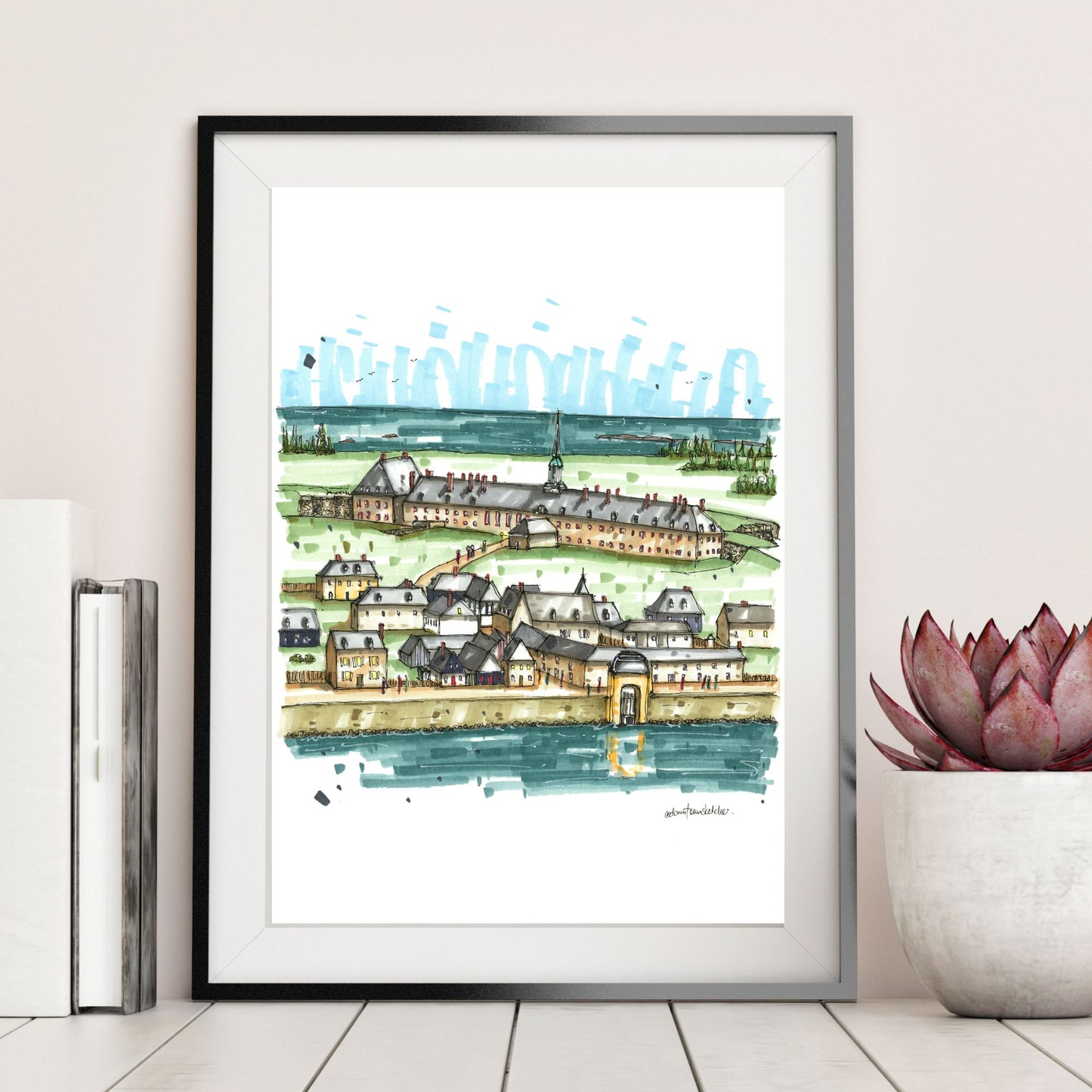
The sketch captures it from above, a sweeping bird's-eye view of the Fortress of Louisbourg spread across the Cape Breton coastline with the Atlantic Ocean stretching out beyond. The reconstructed 18th-century townscape fills the composition, rows of French colonial buildings with steep slate roofs and red chimney stacks clustered within the fortress walls. A church steeple rises above the roofline near the centre, and a winding path connects the inner compound to the outer fortifications. In the foreground, the harbour gate with its distinctive arched yellow portal faces the water, its reflection shimmering in the dark harbour below. Beyond the fortress walls, open green meadows roll towards the treeline and the vast grey-blue Atlantic, giving the scene a sense of both grandeur and isolation that is entirely true to the place.
The Fortress of Louisbourg National Historic Site is the largest reconstructed 18th-century French colonial town in North America, and one of the most remarkable living history sites anywhere on the continent. Originally built by France in the early 1700s as a fortified fishing port and strategic military stronghold on Île Royale, now Cape Breton Island, the fortress played a central role in the contest between France and Britain for control of North America. It was besieged and captured by British forces twice, in 1745 and again in 1758, before being largely demolished. Parks Canada began its remarkable reconstruction in the 1960s, restoring a significant portion of the fortress to its 1744 appearance using original blueprints, archaeological evidence, and meticulous historical research. Today, costumed interpreters bring the site to life throughout the summer, recreating the daily rhythms of soldiers, merchants, tradespeople, and townspeople who once called Louisbourg home. The fortress sits on a rugged stretch of Cape Breton's Atlantic coast, about 35 kilometres from the town of Glace Bay and an hour's drive from Sydney, making it a centrepiece of any Cape Breton itinerary. For anyone drawn to early Canadian history, military heritage, or simply the dramatic beauty of the Cape Breton coastline, Louisbourg is unlike anywhere else in the country.
FOR ART PRINTS:
- Sizes available are: 5"x7", 8"x10", 9"x12" and 11"x14".
- Reproduced on high-quality 100lb paper and archival ink so your art will last for years to come! Ready to frame for wall art. Colours may vary due to screen/monitor settings.
- Framing: We do not offer framing at this time.
PAPER & DESCRIPTION
- Print and cards are of my original handmade marker sketches.
- For my original work I use Copic, and Winsor and Newton alcohol-based ink markers.
- Prints are signed by the artist.
PACKAGING
Prints: All prints are packaged with love, sealed in an eco-friendly, compostable cello sleeve made of plant fibres with thick backing cardboard and mailed in a non-bend envelope to ensure the print remains in perfect condition.
ECO EFFORTS
- It's very important to us to keep being as eco-friendly as possible.
- PLA compostable sleeves and recycled postcards.
- We welcome and encourage any suggestions you might have.
Follow Wynand's artwork under @downtownsketcher on Instagram!
https://www.instagram.com/downtownsketcher/
COPYRIGHT
***************
Any unauthorized reprint or use of this image is strictly prohibited. No part of the artwork may be reproduced, resold, or used for promotional or social media use without written consent from the artist of © Wynand van Niekerk, @downtownsketcher.
Copyright © Wynand van Niekerk ALL RIGHTS RESERVED
Materials
Materials
Alcohol based markers, Copic markers, Winsor and Newton markers, Farber Castell fine liners and card
Shipping
Shipping
Free Domestic & International shipping
Dimensions
Dimensions
Prints available in 4 sizes: 5'x7', 8'x10'. 9'x12', 11'x14'
Originals available in 9'x12' only
Care Instructions
Care Instructions
It's important that you should care for your fine art prints just as you would any delicate and valuable artwork. With proper handling, your prints will remain in pristine condition for many years to come.
Follow these recommendations:
Handling
Natural skin oils or other contaminants can easily transfer to the print. As a preventative measure, we recommend washing your hands before touching the print. Use both hands and support the back of the print when picking it up.
Never attempt to rub the surface of the image with your finger or fingernail as this could scratch the surface of the print.
Exposure to Elements
Keep your print out of direct sunlight. Even the best quality materials are subject to cracking or fading if exposed to prolonged periods of sunlight. Although normal incandescent light bulbs do not present a problem, fluorescent lights do emit harmful ultraviolet rays.
Hang your print away from areas where airborne grime, dust and pollutants such as cigarette smoke can leave a discolouring residue.
Avoid extreme fluctuations in moisture and temperature. Excessive fluctuations between dryness and humidity, or extreme heat and cold can negatively affect the state of your print. Museums keep the temperature generally around 18 degrees Celsius and a relative humidity of 40%. If the humidity is too high, be on the lookout for mold.
Framing
When framing your print use a good quality glass specifically designed for protecting fine art and photographic images. We also recommend using an acid-free archival mat to prevent the print and glass from touching. Like many artworks, an original is sensitive to light. Please ensure that your framer uses UV resistant/museum glass when framing. This glass will protect the artwork against direct or indirect light for years to come.
Storage
To prevent accidents, store your print away from anything that might press against the image surface. Some objects may not seem sharp enough to damage the print, but you'd be surprised at what will cause a scratch, a tear, or a rip.
Do not stack prints on top of each other. Separate them with pieces of acid-free paper to avoid damage.
Wrap your print well if you plan to transport it. Be sure to put a piece of acid-free paper over the front to protect the print. Rough handling can damage the print so pack it securely.
Do not cover your print with plastic for long periods of time. If there is humidity in the air, the mold may begin to grow. Cotton, acid-free sheets are the best for keeping dust away.
Cleaning
The print should be dusted with a clean, soft rag, to prevent dust buildup. Never use cleaning products or water as this may permanently damage the print.
Do not blow on your print as you may inadvertently deposit water droplets that can mark your print.
If using compressed air, apply short bursts while keeping the nozzle at least 12" back from the face of the print.
Share


-
FREE SHIPPING
Free shipping domestic or international
-
BUY 3 GET 15% OFF
Buy three prints from our shop and get 15% off your order! Use CODE:BUY3 at checkout to redeem offer.